The Iraqi economy has entered one of its most challenging periods in recent years, as pressures intensify on the oil sector, which remains the backbone of the national economy. Iraq relies on oil to finance more than 90 percent of public budget revenues, while oil exports account for the overwhelming majority of foreign-exchange earnings. Any disruption in oil production, exports, or prices therefore has a direct impact on the state’s ability to spend and finance public-sector salaries, basic services, and investment.
Despite possessing the world’s fifth-largest proven crude oil reserves, this immense resource base has failed to translate into a foundation for sustainable economic development. The economy continues to suffer from limited diversification, high unemployment, and a private sector heavily dependent on government spending, alongside fragile infrastructure and persistent administrative and financial corruption.
Supporting Market Stability
The current crisis is evident on several fronts. On one front, production quotas imposed by the OPEC+ alliance constrain output levels in an effort to support global market stability. This limits Iraq’s ability to increase exports to offset lower prices, prompting Baghdad recently to request an increase in its OPEC quota in light of its economic circumstances and financing needs.
At the same time, crude exports from the Kurdistan Region through Türkiye’s Ceyhan port continue to face political and legal challenges. The prolonged dispute has deprived Iraq of hundreds of thousands of barrels per day over extended periods, significantly reducing government revenues.
The decline in oil prices from the record levels seen in recent years has placed additional pressure on the Iraqi budget, which was based on relatively high price assumptions. If prices remain at moderate or low levels, the government could face a widening fiscal deficit, particularly given the growing public wage bill, social subsidies, and government project commitments.
The Scale of Public Expenditure
Fiscal risks are compounded by the structural shift in Iraqi public spending toward operational rather than capital expenditure. A large share of the budget is absorbed by salaries, pensions, and government subsidies, while capital spending capable of creating jobs and improving economic infrastructure receives a smaller share. This model leaves public finances highly vulnerable to fluctuations in the oil market.
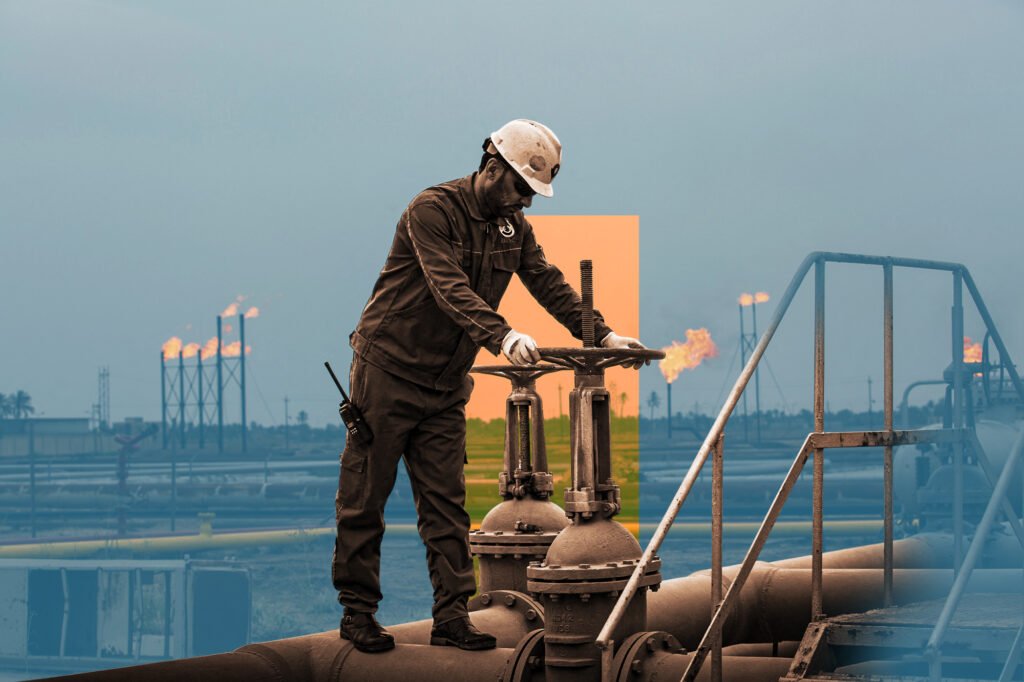
The oil sector itself faces domestic challenges that are no less significant than its external pressures. Many oil fields require substantial investment to maintain or increase production levels. At the same time, projects to capture associated gas continue to progress more slowly than required, leaving Iraq dependent on gas and electricity imports despite its substantial hydrocarbon resources.
Global energy companies are also reassessing their investment decisions amid the worldwide transition toward lower-carbon energy, higher financing costs, and growing geopolitical risks. Unless Iraq improves its investment climate and provides greater legislative and security stability, it may face increasing difficulty in attracting the capital needed to develop its oil and gas fields.
At the macroeconomic level, continued near-total dependence on oil leaves Iraq exposed to what is commonly known as the “resource curse,” in which large flows of oil revenues weaken other productive sectors such as manufacturing, agriculture, and tourism. It also encourages the expansion of the public sector at the expense of private enterprise, limiting the economy’s ability to create sustainable employment for the large numbers of young people entering the labor market each year.
Oil Sector Challenges
Despite these challenges, Iraq’s oil sector still has significant potential if the government succeeds in implementing genuine structural reforms. Iraq possesses vast, low-cost reserves that give it a competitive advantage over many producers worldwide. Global demand for oil is also unlikely to disappear in the foreseeable future, even as the transition toward clean energy accelerates. Most projections indicate that oil will remain a major source of energy over the coming decades, although at a slower rate of growth.
Realizing this potential, however, requires a new strategy built around several priorities: accelerating the development of the gas sector, reducing associated gas flaring, improving the efficiency of oil-field management, strengthening the investment environment, expanding partnerships with international oil companies, and establishing a sovereign wealth fund to invest oil surpluses for future generations while cushioning the domestic economy against price volatility.
At the same time, long-term economic stability cannot be achieved without reducing dependence on oil by developing non-oil sectors, including manufacturing, agriculture, technology, and logistics; reforming the tax system; and encouraging the private sector to become a primary engine of growth rather than relying almost entirely on government spending.
Ultimately, Iraq faces two clear choices: continue with the current oil-based economic model, with all its volatility and risks, or use its existing oil wealth to build a more diversified and sustainable economy. The challenge lies not in possessing oil, but in how its revenues are managed and transformed into meaningful development. Without fundamental structural reforms in the coming years, pressures on the oil sector could develop into a broader financial and economic crisis, threatening the state’s long-term capacity to achieve growth and stability.
Is There an Ongoing Crisis?
The central question is whether Iraq is experiencing an economic crisis. While the country may not be facing a comprehensive economic collapse in the conventional sense, it is confronting a deep structural crisis that threatens the sustainability of economic growth.
The state possesses vast oil resources that generate substantial revenues. Yet the near-total dependence of the public budget on oil exports leaves the economy highly sensitive to global price fluctuations and OPEC+ decisions.
The structural pressures are evident in rising government expenditure, particularly on wages and subsidies, alongside weak non-oil revenues. This limits the government’s ability to finance development projects when crude prices decline. Continuing disputes between Baghdad and the Kurdistan Regional Government over the management and export of oil have also resulted in substantial financial losses and affected production and export levels.
The domestic economy, meanwhile, suffers from a weak private sector, high youth unemployment, and a declining contribution from agriculture and manufacturing to GDP. These problems are compounded by corruption and bureaucratic obstacles that discourage foreign investment.
Despite these challenges, Iraq still has an opportunity to overcome the crisis, supported by its large oil reserves and low production costs. Realizing that opportunity, however, requires fundamental economic reforms, including diversifying sources of income, developing the gas sector, improving the investment climate, and reducing dependence on oil revenues.
Without such reforms, the Iraqi economy will remain vulnerable to external shocks, while public finances will remain highly exposed to fluctuations in global oil markets.
Disclaimer: The views and opinions expressed in this paper are solely those of the author and do not necessarily reflect the official policy or position of the Institute.