Prelude
The monumental architecture of authoritarian regimes is frequently dismissed as political spectacle or relegated to the margins of historical inquiry. This article challenges that assumption by re-conceptualizing such structures as vital, yet largely neglected, archives of transitional justice. Drawing upon extensive expertise in Iraqi archival governance and memory politics, it traces the fate of emblematic sites ranging from the Panorama of Al-Qadisiyyah to the vast Presidential Palaces complex, revealing the deep institutional shortcomings that have shaped Iraq’s post-2003 engagement with the material remnants of dictatorship. Through the introduction of a tripartite analytical framework, Excess, Suspension, and Erasure, the study demonstrates how the destruction, abandonment, and neglect of these sites, together with the documentary records associated with them, have produced an irreversible erosion of the right to truth. Rather than serving as neutral physical remnants of a bygone regime, these structures constitute critical repositories of historical evidence whose loss has weakened opportunities for public accountability, collective reckoning, and democratic memory formation. By situating the Iraqi experience alongside comparative examples from Chile and other countries, the article highlights alternative approaches to confronting difficult heritage and preserving sites associated with state violence and authoritarian rule. It ultimately advances an argument for a new model of heritage governance: one that safeguards the architectural legacies of oppression not to commemorate or legitimize authoritarian power, but to expose, interrogate, and dismantle its ideological foundations. In doing so, the article underscores the essential role of contested built environments in securing the right to truth, fostering civic engagement, and cultivating a more durable and self-critical public memory.
The monumental and architectural legacy of the Saddam Hussein era represents a complex and systematically undertheorized dimension of transitional justice in post-conflict Iraq, one that extends considerably beyond the bounds of legal accountability into the cultural and archival domains through which authoritarian power was constructed, normalized, and perpetuated across decades of Ba’athist governance. As with analogous legacies associated with other former authoritarian regimes, this built heritage must not be reduced to mere aesthetic production or spatial organization. Rather, as Sophia Birman has demonstrated, monumental architecture under authoritarian governance functions as a calculated instrument of political control, deploying massive scale, formal symmetry, and classical preferentiality to render state authority psychologically incontestable and historically immutable. [1] In this sense, such structures operate as material-visual archives; spatially organized repositories that encode and transmit the political, ideological, and administrative logics constitutive of a given historical order, and whose destruction or neglect therefore constitutes not merely an aesthetic or heritage loss but an archival one, eliminating evidentiary material whose significance for historical accountability is no less consequential than that of the documentary records examined throughout the preceding sections of this study.
Critically engaging with this legacy in post-2003 Iraq demands a methodologically rigorous framework capable of reconciling two analytically distinct yet ethically interdependent imperatives: the preservation of material evidence in accordance with the archival principle of provenance, and the achievement of symbolic redress for those who suffered under the regime’s authority. Comprehensive documentation of relevant sites, conducted systematically prior to any alteration, removal, or repurposing, would constitute an indispensable component of the right to truth and the institutional guarantee of non-recurrence. This undertaking assumes particular urgency within the cultural dimension of transitional justice, a domain that reaches beyond prosecutorial accountability and reparative mechanisms to encompass a broader set of decisions concerning mass graves, detention facilities, classified state archives, security and intelligence headquarters, military concentration camps, and the wider monumental infrastructure through which the former regime sought to legitimize and consolidate its authority. When situated within a comprehensive transitional justice framework, the administrative and technical records associated with such structures acquire substantial epistemic and political significance: their systematic integration into heritage governance processes would facilitate the transformation of these sites into critically curated spaces of memory, institutions capable of sustaining rigorous historical inquiry, fostering public acknowledgment of past atrocities, and contributing meaningfully to the longer-term project of social reconciliation. The failure to develop such a framework does not produce a neutral outcome; it produces precisely the kind of institutionally compromised and historically incoherent memorial landscape in which the victims’ memory is literally framed by the glorification of their persecutors; a condition that illustrates, in spatial and symbolic form, the same logic of selective and politically governed memory that has characterized Iraq’s archival politics throughout the period examined in this study.
Since the conclusion of the Second World War, transitional justice has evolved into a sophisticated and institutionally diverse field, encompassing an expanding repertoire of mechanisms, among them criminal prosecutions, truth commissions, reparations programmes, and structural institutional reforms, collectively oriented toward confronting the legacies of systematic repression and establishing the normative and procedural foundations upon which democratic governance may be constructed. Nevertheless, the field has exhibited a persistent and analytically consequential tendency to neglect the cultural and symbolic infrastructure through which authoritarian rule is not merely enforced but rendered epistemically coherent, made to appear natural, historically ordained, and politically inevitable at the level of lived collective experience. Authoritarian regimes, as a structural feature of their governance, invest substantially in the cultivation of ideological environments that complement and extend their coercive apparatus, constructing through architecture, urban planning, commemorative practice, and monumental production the conditions under which the concentration of power appears as the expression of historical necessity rather than as the outcome of organized violence.
In the Iraqi context, this ideological architecture assumed concrete spatial and monumental form across a range of sites, whose significance for the analysis of the Saddam governance extends far beyond their physical dimensions. Sites such as the Panorama of Al-Qadisiyyah, the extensive network of presidential palaces distributed across the national territory, and prestige projects of the scale and ambition of the Al-Rahman Mosque collectively constituted nodes within a broader and coherently organized system through which collective identity, political authority, and historical meaning were produced, managed, and disseminated to populations simultaneously subjected to surveillance, repression, and the systematic destruction of autonomous civil and cultural life. These sites did not merely embody the former regime’s worldview in a passive or incidental sense; they actively communicated and reproduced it, shaping the horizons of public perception, structuring collective memory, and mobilizing populations in the service of ideologically framed military and political conflict. As Gavriel Rosenfeld’s foundational study of the built environment of the National Socialist era in Germany demonstrates, architecture and urban planning function as primary instruments through which societies engage, whether critically, ambivalently, or evasively, with the material residues of violent and repressive histories. [2] Rosenfeld’s analysis reveals how the negotiation of such spaces is never politically neutral: it constitutes a site of active contestation over the terms of historical memory and collective self-understanding, whose outcomes carry consequences for the credibility and coherence of the transitional justice framework within which they occur.
It follows from this that the preservation of such sites within a post-authoritarian context ought not to be construed as an act of commemoration, still less of legitimation, as maintained by hardline Shiite Islamist factions. On the contrary, when approached through a critically informed heritage framework, these structures offer an exceptionally productive opportunity for rigorous public inquiry into the mechanisms, aesthetics, and spatial logics of state violence, transforming the material instruments of authoritarian self-representation into resources for historical accountability, civic education, and the sustained interrogation of how power naturalizes itself through the built environment. The central question at the moment of regime change was therefore not merely whether post-2003 Iraq’s new rulers recognized the evidentiary value of preserving such sites, but whether they possessed the institutional capacity, the political will, and the archival understanding necessary to govern that preservation in ways commensurate with its transitional justice significance. The analysis that follows demonstrates that they did not; and that the consequences of this failure for Iraq’s historical record are, in significant respects, irreversible.
The Panorama of Al-Qadisiyyah constitutes a particularly instructive and analytically productive case study in the relationship between monumental culture and authoritarian ideological production and, by extension, in the consequences of the failure to develop a principled heritage and archival response to the monumental legacy of the Saddam era. Inaugurated at the onset of the Iran–Iraq War, the complex was conceived and operationalized as a state-sponsored instrument of mass ideological mobilization, strategically designed to manufacture popular consent for a protracted and enormously costly military engagement. Through the deliberate revival and reactivation of the seventh-century Battle of Al-Qadisiyyah, the regime recoded a contemporary geopolitical conflict of considerable regional complexity as a civilizational struggle of ancient character; a confrontation between Arabs and Persians that transcended historical contingency and assumed the character of cultural destiny. This ideological reframing served a precise political function: by presenting the war as the continuation of an ancient and celebrated triumph, the regime positioned Saddam Hussein not merely as a head of state but as the legitimate inheritor of a deep historical legacy, endowed with the quasi-mythological authority of his seventh-century predecessors and thereby elevated above the reach of ordinary political accountability.
The Panorama of Al-Qadisiyyah project formed part of a broader state-led undertaking in which the former regime mobilized Iraqi historians, archaeologists, and ideologues to recast both Mesopotamian and modern Iraqi history in accordance with Ba’ath Party ideological premises, a project that relied extensively upon archival materials selectively interpreted and strategically framed to support a predetermined political narrative.[3] This archival dimension of the Panorama’s production is significant beyond the documentary: it reveals that the regime’s monumental programme was not merely a spatial phenomenon but an archival one, dependent upon the controlled deployment of historical records to legitimate the ideological claims embedded in the built environment. The systematic destruction of the administrative and documentary records associated with this project in the post-invasion period thus eliminated not merely architectural documentation but the evidentiary basis for understanding how historical archives were themselves instrumentalized as resources of ideological production; a loss whose consequences for the critical analysis of pre-2003 governance extend well beyond the domain of architectural history.
The strategy of ideological mobilization deployed through the Panorama extended well beyond the conventions of institutional propaganda. It entailed the systematic appropriation and reorganization of historical narrative through an arsenal of immersive sensory techniques, elaborate sound and light installations, dense religious symbolism, and carefully choreographed narratives of heroism and martyrdom, through which emotional engagement was cultivated and the boundary between historical representation and contemporary political participation was deliberately dissolved. The regime’s instrumental incorporation of Islamic motifs within what was formally presented as a secular nationalist framework is itself analytically significant, revealing the fundamentally opportunistic character of the Saddam ideological production: a system prepared to draw upon any available symbolic register, religious, historical, civilizational, or mythological, in the service of immediate political objectives, and whose coherence derived not from ideological consistency but from the organizational capacity to manage and deploy symbolic resources in the service of power.
The Panorama simultaneously functioned as a mechanism of internal exclusion and socio-political control, whose significance is no less analytically consequential than its external mobilizing function. Its master narrative constructed a rigid binary opposition between Arab and Persian civilizational identities; a discursive structure that necessarily entailed the systematic erasure of the profound ethnic, sectarian, and cultural diversity that has historically constituted Iraqi society. Shiite, Kurdish, Turkmen, Christian, and other communities whose identities could not be absorbed into or reconciled with the regime’s ethno-nationalist vision were rendered entirely invisible. The monument thus served a dual and internally coherent function: as an instrument of external military mobilization and, simultaneously, as a mechanism of internal symbolic homogenization, whose effect was to impose upon Iraq’s genuinely plural society the imaginary of a culturally unified Arab nation marching under the Saddam leadership toward civilizational destiny. This duality illuminates the degree to which cultural production under the pre-2003 regime was not peripheral to its governance, but embedded within and constitutive of its broader strategies of political administration, social control, and archival management.
The destruction and systematic neglect of this site in the post-2003 period represents a loss of the first consequence for the project of transitional justice; one whose full implications remain insufficiently acknowledged in both scholarly and policy discourse. Demolition and abandonment eliminated not only physical structures of historical significance, but also irreplaceable evidentiary archives documenting the mechanisms through which authoritarian ideology was produced, operationalized, and sustained at the level of lived collective experience. The failure to preserve and critically reinterpret this monument foreclosed substantial opportunities to examine with analytical precision how historical myths were constructed and disseminated through the selective deployment of archival and historical materials, how collective identities were formed and policed, and how entire populations were mobilized through the strategic management of symbolic resources. The conflation of preservation with endorsement, a reductive position that certain strands of post-invasion political culture advanced with considerable force, misrepresents the fundamental character of critically informed heritage governance. Preservation, within a rigorous transitional justice framework, does not reproduce the logic of domination; it exposes and subjects that logic to sustained critical interrogation, converting the material instruments of authoritarian self-representation into resources for historical accountability and civic education. A site approached in this manner does not commemorate the regime, as maintained by the pro Iran Shiite groups responsible for its post 2003 destruction. Rather, it documents and dismantles its ideological apparatus, transforming what was once a vehicle of mass deception into an instrument of collective critical understanding.
Comparative international experience furnishes compelling evidence for the analytical value and practical viability of such approaches across diverse post-authoritarian contexts. In Chile, Villa Grimaldi, once among the most notorious clandestine detention and torture centres operated by the Pinochet dictatorship, was reconstituted as a Park for Peace, incorporating architectural replicas of holding cells and a commemorative Wall of Names, enabling visitors to confront the spatial and material reality of state-sponsored disappearance within an explicitly human rights-oriented educational framework.[4] A locally significant precedent exists within Iraq itself: in the city of Sulaimani in the Kurdistan Region, the former regime’s detention and torture facility known as Amna Suraka (literally, the Red Security) has been transformed into a museum of conscience that documents with forensic precision the systematic brutalities perpetrated within its walls, while serving as a primary educational institution for successive generations seeking to understand the scale of the regime’s atrocities against the Kurdish population, most notably during the genocidal Anfal campaigns of 1988. Together, these cases demonstrate that the transformation of sites of repression into critically curated spaces of memory is not only ethically defensible but institutionally practicable, and that such transformations constitute among the most powerful instruments available to post-authoritarian societies committed simultaneously to historical accountability and the structural prevention of future violence. The contrast between these successful examples and the compromised repurposing of the Martyrs Memorial reveals with particular clarity an institutional preference for sanitized and politically manageable memory. As demonstrated previously, the Martyrs Foundation directed its institutional resources toward recasting a monument originally constructed to serve the dictator’s ideological project, rather than toward the authentic preservation and critical reinterpretation of sites that materially embody the architecture of repression. This institutional choice comes at the expense of the more demanding and direct engagement with historical truth upon which any credible process of transitional justice depends.
A theoretically generative perspective emerges from the analysis of the unfinished structure commonly designated as the Al-Rahman Mosque; a site whose very incompletion renders it one of the most analytically revealing monuments of the post-Saddam landscape. Unlike the Panorama of Al-Qadisiyyah, whose ideological function was realized through the full deployment of its immersive apparatus, the Al-Rahman Mosque derives its significance precisely from its suspended and unresolved condition. Commissioned in 1999 under conditions of acute international economic pressure imposed through the United Nations sanctions regime, and subsequently abandoned as a direct consequence of the 2003 invasion and the political order it irrevocably disrupted, the structure embodies what might be analytically designated as a moment of systemic collapse. It serves as a material inscription of the point at which state authority ceased to be capable of translating political ambition into completed spatial form, and at which the gap between the regime ideological self-representation and its actual institutional capacity became architecturally visible.
Its continued physical presence in the urban landscape does not, however, signify mere architectural failure or administrative neglect. On the contrary, the mosque’s incompletion performs a distinctive and irreplaceable archival function: it externalizes and renders visible the fragmentation of political authority, the layering of competing sovereignties, and the profound instability of historical meaning that collectively characterize Iraq’s recent national experience. Where a completed structure would impose a singular and finished ideological statement upon the built environment, the unfinished one preserves the trace of historical rupture itself, maintaining in permanent suspension the irresolution of the political contest that produced it; functioning, in this respect, as an architectural correlate of the condition of structured archival precarity that Part One of this study identified as the defining feature of Iraq’s post-invasion documentary landscape.
As Meriam Othman has argued with analytical insight, the unresolved status of the site, originally designated within a Sunni confessional framework, actively exposes the ongoing and deeply contested struggle over political meaning in post-2003 Iraq.[5] The successive transfers of effective control over the structure across competing actors, most notably the Shiite Al-Fadhila Party, have progressively transformed the site into a spatial proxy for the broader sectarian and ideological antagonisms that continue to structure Iraqi political life. Within this framework, any act of completion would constitute not a neutral architectural decision but a profoundly consequential political intervention; one that would necessarily impose a singular and exclusionary historical narrative upon a site whose significance derives precisely from its capacity to hold multiple, irreconcilable interpretations in unresolved tension. The normative and institutional implications of this analysis are significant: Othman’s proposal that such sites be reimagined as inclusive civic spaces, neither completed according to any singular confessional or ideological programme nor erased in the service of a false narrative of historical closure, offers a model for engaging with the architectural residues of authoritarian governance. This approach proceeds from the recognition that the interpretive openness of the unfinished or critically preserved monument constitutes an asset rather than a deficiency, allowing the built environment to function as a medium through which historical complexity is acknowledged, competing memories are rendered mutually legible, and the aspiration toward coexistence is given spatial and institutional expression. In contradistinction to positions that seek to resolve contested heritage through either demolition or ideologically directed completion, this model resists premature closure, allowing architecture to perform what legal and prosecutorial mechanisms frequently cannot, the sustained acknowledgment that the meaning of a violent and contested past remains, legitimately and necessarily, a matter of ongoing collective negotiation.
The problematic of unresolved architectural heritage that structures the analysis of the Al-Rahman Mosque finds a parallel, and in certain respects more expansive, instantiation in the extensive network of presidential palaces constructed under the Saddam regime; a patrimony numbering between eighty and one hundred discrete complexes distributed across the national territory, constituting perhaps the most materially substantial and spatially pervasive dimension of the regime’s monumental legacy. The overwhelming majority of these complexes were commissioned and constructed in the aftermath of the 1991 Gulf War; a period in which the regime, having survived military defeat and the imposition of punishing international sanctions, embarked upon an extraordinary programme of monumental self-assertion that was as much a response to internal vulnerability as an expression of consolidated power. The spatial and material logic of this programme was one of deliberate and systematic excess: colossal scale, conspicuous material opulence, and a heterogeneous stylistic hybridity that drew simultaneously upon Babylonian, Islamic, and European neoclassical referential registers served collectively to project an image of sovereign permanence and civilizational authority. As Owen Vince has argued with particular analytical precision, these structures were never conceived or functioned as mere residential accommodation; they operated as integrated instruments of political control, foreign policy performance, and authoritarian spectacle, engineered through their overwhelming physical dimensions and calculated aesthetic assertiveness to intimidate, overwhelm, and render the coercive foundations of the regime’s authority spatially and psychologically incontestable.[6]
In this respect, the palatial network constitutes an architectural correlate of the ideological apparatus analyzed in the preceding sections; a built environment designed not merely to house power but to naturalize and perpetuate it, functioning alongside the documentary apparatus of surveillance and the administrative machinery of nationality control as a constituent element of the regime’s integrated system of domination. The ceremonial and administrative functions of these complexes further reinforced their role within the broader architecture of governance: serving simultaneously as sites of state ritual, diplomatic reception, and the physical inscription of sovereignty across the national landscape, the palaces encoded within their spatial organization the hierarchical and exclusionary logics that structured pre-2003 political culture more broadly. Their distribution across the territory, from Baghdad to Tikrit, from Mosul to Basra, was itself a form of political cartography, a material assertion of the regime’s claim to total spatial dominion over the Iraqi national body.
The post-2003 fate of the majority of these structures remains, to the present, profoundly and consequentially unresolved. A minority of complexes have been subjected to ad hoc repurposing for cultural, educational, or governmental functions that bear no systematic relationship to the heritage significance of the sites in question; a pattern that reproduces, at the level of palatial architecture, precisely the logic of institutionally uncoordinated and politically contingent disposition that the preceding section identified in relation to the Martyrs Foundation’s treatment of the Martyrs Memorial: resources channeled into the repurposing of regime-era structures for purposes of immediate political utility rather than into the principled and archivally grounded transformation of sites into genuine instruments of historical accountability. A notable exception, instructive precisely because of the conditions that enabled it, was the conversion of one of Saddam Hussein’s palaces in Basra into an archaeological museum, a project driven primarily by external actors, notably British institutions that provided funding, technical expertise, and curatorial supervision.[7] The external origin of this initiative is itself analytically significant: it confirms that where principled heritage transformation occurred in post-2003 Iraq, it did so largely despite rather than because of the institutional framework of the Iraqi state’s transitional justice apparatus.
The majority of palatial complexes have been left in conditions of varying abandonment, deterioration, or contested appropriation by competing institutional actors whose claims bear no relationship to any coherent heritage policy. This condition is not, as Vince correctly observes, a merely administrative or logistical failure; it reflects and symptomatizes a deeper political and cultural uncertainty concerning the terms on which post-authoritarian Iraqi society is prepared to engage with the material residues of its most recent experience of systematic oppression; an uncertainty whose archival dimension is as consequential as its spatial one. The absence of a coherent national heritage policy capable of addressing this network of sites in a manner commensurate with their historical and evidentiary significance represents a substantial and structurally revealing gap in Iraq’s transitional justice architecture, one with direct implications for the right to truth, the construction of critical public memory, and the long-term project of democratic consolidation.
Vince’s advocacy for the systematic transformation of these complexes into accessible civic spaces and critically curated museum environments deserves serious engagement as a policy proposition within this framework. Such a programme of conversion would serve a tripartite function of considerable transitional justice significance. It would, in the first instance, enable ordinary Iraqi citizens to physically access and critically engage with spaces from which they were categorically excluded under the former regime; an act of symbolic re-appropriation whose civic and psychological dimensions are not reducible to mere heritage management. It would, secondly, provide institutional infrastructure for the critical demystification of the aesthetic and spatial strategies through which authoritarian authority constructed its claims to permanence and legitimacy, transforming the built environment of domination into a publicly accessible object of critical historical inquiry. And it would, thirdly, contribute to the broader project of historical accountability by preserving within the public domain a material record of the scale, the ambition, and ultimately the fragility of a regime that sought, through the systematic monumentalization of power, to place itself beyond the reach of historical judgment.
The preservation and contested afterlife of the Great Celebrations Square in Baghdad offers what is perhaps the most analytically rich and institutionally instructive case study in the broader problematic of how post-authoritarian Iraqi society has engaged, haltingly, ambivalently, and without the guidance of any coherent national heritage policy, with the monumental legacy of the Saddam regime. The square’s post-2003 trajectory illuminates with particular clarity the intersection of competing political imperatives, sectarian reconfigurations, and unresolved questions of historical memory that collectively structure the field of transitional heritage governance in Iraq.
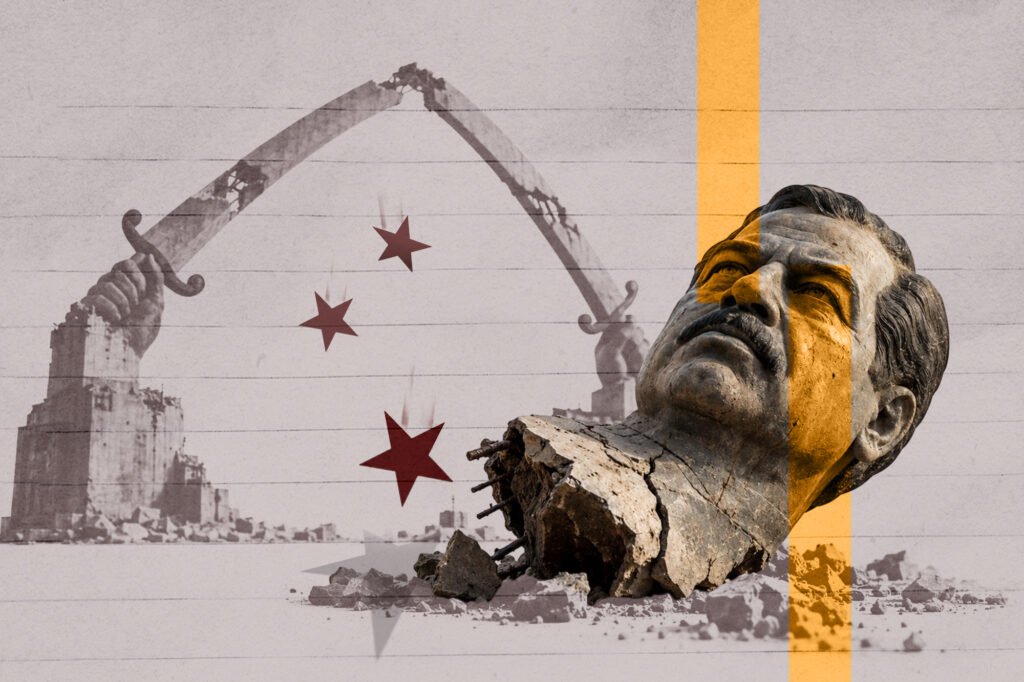
The monument’s reception has been marked, from its inception, by a profound and analytically revealing interpretive instability. As Kirk Semple has observed, the complex has attracted a strikingly heterogeneous range of aesthetic and political characterizations, simultaneously magnificent and vulgar, heroic and insulting, graceful and grotesque, inspiring and kitschy,[8] a proliferation of contradictory judgments that is itself analytically significant, reflecting not merely subjective aesthetic disagreement but the deeper ideological incoherence of a monument whose production was shaped in an unusually direct and well-documented manner by the personal intervention of the dictator himself. Rather than commissioning a conceptually elaborated programme and entrusting its artistic realization to gifted practitioners, Saddam Hussein personally produced the initial sketches from which the project derived, subsequently engaging professional artists, among them the eminent Iraqi sculptors Khalid Al-Rahal and, following Al-Rahal’s untimely death, Mohammed Ghani Hikmat, to fabricate his vision under conditions of direct and unrelenting presidential supervision. As Kanan Makiya, writing under the pseudonym Samir Al-Khalil, has argued in his critical study of the monument, this mode of production generated a form of state-sponsored tastelessness that systematically vulgarized the concept of turath, the Arabic cultural and civilizational heritage, by instrumentalizing it as a vehicle for regime propaganda.[9] Makiya’s characterization of the Victory Arches as a “gargantuan Ba’athist bowling trophy” articulates, with precision, the aesthetic and ethical failure of a monument that substituted the glorification of a personalist dictatorship for the genuine memorialization of collective sacrifice.
The conceptual and spatial organization of the square was structured around three principal monumental elements that together articulated a coherent, if ideologically tendentious, narrative of martial sacrifice and inevitable national triumph. The Monument to the Unknown Soldier, replacing its predecessor closely associated with Abdul Karim Qasim, overthrown and killed by the Ba’athists in the February 1963 coup, was inaugurated in 1982 at the height of the Iran–Iraq War, intended to serve as an official site of mourning and commemoration. Yet its deliberate formal abstraction simultaneously worked to obscure the vast human cost of the conflict, distancing collective grief from any critical reflection on the political decisions that had brought about such loss. The Victory Arches, completed in 1989 as the war reached its inconclusive and devastatingly costly close, constituted the most overtly propagandistic feature of the complex: their colossal sculpted arms, modelled explicitly upon Saddam Hussein’s own, grasping swords forged from the melted weapons of fallen Iraqi soldiers represented a calculated fusion of personalist cult and martial triumphalism of an extreme order. The deliberate incorporation of captured Iranian military helmets, suspended in nets at the base of the arches, further transformed the structure into a theatrical and dehumanizing representation of victory over a constructed enemy, an architectural manifestation of the civilizational binary that pervaded the regime’s broader ideological apparatus. These central monumental features were embedded within an extensive spatial complex, incorporating parade ground, review pavilion, reflecting pool, and stadium, designed to function as infrastructure for mass spectacle, supplemented by Al-Mansour Cinema, Al-Mansour Theatre, and the Fine Art Hall, transforming the square from a site of commemoration into a comprehensive apparatus for the continuous reproduction of state ideology across multiple registers of public life.
The collapse of the regime in April 2003 inaugurated a prolonged and institutionally unresolved period in the square’s history. The efforts of Nuri Al-Maliki, the then prime minister in 2007 to demolish the Victory Arches, driven by the confluence of sectarian repositioning and ideological revisionism characteristic of the immediate post-invasion political conjuncture, encountered significant and ultimately decisive resistance from domestic cultural actors, international heritage stakeholders, and the United States Embassy in Baghdad, resulting in the indefinite suspension of the demolition programme. This episode is instructive from a transitional justice perspective for what it reveals about the competing institutional logics at work in the post-2003 monumental landscape. The demolition impulse reflected a political instinct to erase the material symbols of the former regime as a substitute for more substantive forms of historical accountability; a pattern whose institutional logic was directly analogous to the Martyrs Foundation’s impulse to channel commemorative resources into the cosmetic repurposing of regime-era structures rather than into the authentic and archivally grounded transformation of sites associated with genuine victim experience. Both impulses, demolition as symbolic erasure and repurposing as symbolic appropriation, represent failures of the same fundamental kind: the subordination of principled heritage governance to the immediate political requirements of the dominant constituencies that control the institutional apparatus of the transitional justice framework. The resistance to demolition that preserved the Victory Arches, while not itself grounded in any coherent heritage or transitional justice framework, at least averted the irreversible loss of a structure whose critical reinterpretation remained, and remains, possible. The same cannot be said for the Panorama of Al-Qadisiyyah, whose physical destruction combined with the simultaneous loss of its associated documentary archives to foreclose permanently certain categories of historical understanding.
The partial restoration of the site undertaken in 2011, including the significant decision to remove suspended Iranian military helmets from the base of the Victory Arches, represented an attempt to recalibrate the monument’s symbolic register in response to the shifting sectarian and regional political landscape of post-occupation Iraq, without subjecting this recalibration to any transparent or participatory process of public deliberation. The eventual reopening of the square in June 2023, accompanied by the gradual rehabilitation of its associated cultural institutions, marked a transition of symbolic significance, from a space of militarized spectacle and ideological mobilization to one oriented, at least in principle, toward artistic practice and civic engagement. Whether this transition has been accompanied by a critically informed interpretive framework enabling visitors to engage analytically with the monument’s authoritarian genesis and ideological functions remains, however, a question that existing documentation does not permit to be answered with confidence.
This ambiguity is rendered more acute, and more consequential for the transitional justice framework developed throughout this study, by what constitutes perhaps the most significant and least recoverable dimension of the square’s post-2003 fate: the near-total disappearance of the documentary archive associated with its conception, planning, and production. Technical drawings, architectural plans, artistic designs, administrative correspondence, procurement records, and the directives issued by Saddam Hussein himself in the course of his personal supervision of the project have been either deliberately destroyed in the disorder of the invasion and its aftermath, or dispersed across an indeterminate range of private and institutional repositories to which systematic scholarly access has not been established. This archival gap is not a peripheral or merely technical loss; it represents a fundamental impoverishment of the evidentiary basis upon which critical historical interpretation of the monument must rest. The disjunction between the physical survival of the site and the effective disappearance of the institutional records that produced it reduces the monument to a partially intelligible artefact, severed from the bureaucratic, aesthetic, and ideological processes that gave it form and meaning, in precisely the same way that the Martyrs Memorial’s makeshift conversion produced a palimpsest in which victims’ memory was framed by the glorification of their persecutors in the absence of the archival records and contextualizing documentation necessary to transform an exhibition of decontextualized artefacts into a historically grounded act of reckoning. In both cases, the absence of archival governance, whether through the dispersal of records associated with monumental production or the failure to integrate documentary evidence into commemorative spaces, produces an equivalent condition of historical incoherence whose consequences for transitional justice are equally consequential.
A structurally analogous dynamic, yet one that illuminates a distinct and equally consequential dimension of the politics of monumental preservation in post-2003 Iraq, is discernible in the case of the Al-Quds Gate; a structure whose post-invasion trajectory diverges markedly from those of the monuments already examined and whose continued presence within Baghdad’s International Zone demands analytical attention precisely because it resists straightforward categorization within the dominant frameworks of either subversive erasure or critical heritage re-appropriation. Unlike the Victory Arches, which attracted immediate demolition proposals driven by sectarian and ideological repositioning, or the Al-Rahman Mosque, whose unresolved condition reflects the absence of any consensus capable of determining its future, the Al-Quds Gate has been subjected to neither systematic demolition nor deliberate neglect. This relative preservation cannot, however, be attributed to the operation of any principled or institutionally coherent heritage policy; it reflects rather the particular and historically contingent symbolic register with which the structure has been associated, namely, its invocation of the Palestinian cause and the enduring resonance of that cause across the full spectrum of post-2003 Iraqi political actors, whose ideological orientations are otherwise profoundly and often antagonistically divergent.
The Palestinian symbolic register has functioned, in this context, as a politically portable and ideologically adaptable resource, capable of being appropriated and instrumentalized by successive political formations, Saddam’s successors, Islamist movements, nationalist factions, and regional proxy actors alike, without requiring any of them to engage substantively with the monument’s authoritarian provenance or the political conditions of its production. This pattern of selective and instrumentally motivated preservation constitutes one of the most analytically revealing features of Iraq’s post-authoritarian monumental landscape. It exposes with particular clarity the degree to which decisions concerning the fate of the former regime’s architectural legacy have been determined not by any systematic application of transitional justice principles, the right to truth, the guarantee of non-recurrence, the imperative of critical historical documentation, but by the immediate political utility that individual structures retain for competing actors within the post-invasion order.
The architectural design of the Al-Quds Gate is itself analytically significant in this connection. Its mixed stylistic register, combining elements from Islamic, Arab nationalist, and modern political symbolic vocabularies, reflects the complex and often contradictory cultural and political meanings the structure has absorbed over time. This mixture is not merely an aesthetic feature; it operates as an archive, preserving within the building itself the history of political use and ideological adaptation that the monument has undergone across successive political orders. In this way, the Al-Quds Gate embodies, with particular architectural clarity, the central argument of this study: that the monumental remains of authoritarian rule function as irreplaceable material archive whose value lies in their capacity to contain within a single structure the conflicts, adaptations, and competing meanings of an entire historical era. Approaching such structures through a logic of political utility, retaining what remains symbolically serviceable and discarding what does not, forecloses precisely the kind of deep historical understanding that transitional justice, in its full cultural and archival dimension, requires. The comparison with the Martyrs Foundation’s institutional preference for the politically manageable repurposing of the regime-era Martyrs Memorial over the authentic preservation and critical reinterpretation of genuinely victim-centered sites such as Nagrat Al-Salman Prison is directly applicable here: in both cases, the logic of immediate political serviceability displaces the logic of principled historical accountability, producing a memorial and monumental landscape that reflects the political requirements of the present rather than the evidentiary obligations of the past.
The archival dimension of this architectural legacy demands engagement with no less analytical rigour than the physical and spatial dimensions already examined. It is precisely in the systematic destruction, dispersal, and neglect of associated documentary records that the most irreversible losses of the post-2003 period have been sustained. The demolition or abandonment of monumental structures, however consequential, leaves at least a material residue; a site, a ruin, a spatial trace, upon which critical interpretation may, however partially, be exercised. The disappearance of the archival records that produced those structures forecloses interpretation at its most fundamental level, eliminating the evidentiary basis upon which the institutional logics, political calculations, and ideological negotiations that generated the built environment can be reconstructed with analytical precision and historical accountability.
The establishment of a dedicated and systematically organized archival repository for all written, audio-visual, and technical records associated with the monumental projects of the Saddam era, whether completed, abandoned at various stages of realization, or merely conceived and never executed, would have constituted an institutional resource of exceptional and irreplaceable scholarly and juridical value. Such a repository would have preserved not only architectural plans, engineering specifications, and technical documentation but also the broader epistemic and administrative framework within which these projects were conceived, politically justified, economically resourced, and materially executed. Monumental construction under the Saddam regime was, as this study has sought to demonstrate across its successive case analyses, the product of profoundly multifaceted intersections of political ambition, ideological projection, economic allocation, and symbolic communication; intersections whose reconstruction requires access to the full spectrum of primary documentation rather than to physical structures alone.
A centralized archival institution would have enabled Iraqi and international scholars to trace with methodological rigour the processes through which decisions moved from conceptual design through administrative authorization to material realization, as in the case of the Great Celebrations Square, or, in the case of uncompleted projects such as the Al-Rahman Mosque, to document with precision how shifting political priorities, economic constraints, or moments of regime crisis interrupted, redirected, or indefinitely suspended their trajectory. The systematic inclusion of audio-visual materials, ceremonial recordings, promotional media productions, and the speeches through which senior regime figures publicly framed and legitimized monumental projects, would have provided an additional and analytically indispensable layer of documentation, illuminating the mechanisms through which architecture was mobilized as an instrument of mass persuasion, ideological consolidation, and political control. From the intersecting perspectives of historiography and transitional justice, the absence of such an institutional archive represents a loss, whose consequences extend well beyond the domain of academic scholarship: without systematic preservation, the historical record of the Saddam regime’s monumental production has become irreversibly fragmented, severely constraining the capacity to analyze not only what was built and how it functioned ideologically, but also, and perhaps more significantly, what was imagined, proposed, and never realized. Within the framework of transitional justice, such a repository would have performed an additional and equally consequential function: supporting the right to truth in its cultural and ideological dimensions by enabling future generations to examine with documentary precision the enormous financial resources allocated to monumental construction, resources extracted from a population simultaneously subjected to conditions of severe and deliberately maintained economic deprivation, and to subject the processes through which architecture functioned as an instrument of authoritarian governance to the forms of critical scrutiny that accountability demands and that irreversible archival loss now renders permanently incomplete.
The structural limitations of Iraq’s post-2003 transitional justice process are nowhere more clearly symptomatized than in its systematic neglect of these cultural and archival dimensions. The de-Ba’athification policies that constituted the primary institutional response to the former regime’s legacy were oriented almost exclusively toward the removal of personnel from positions of administrative and political authority, implemented, moreover, in a manner that was widely characterized as politically selective, institutionally inconsistent, and juridically uneven. This narrow and predominantly punitive focus left entirely unaddressed the ideological infrastructure, the symbolic systems, the monumental apparatus, the cultural production mechanisms, through which the regime had constructed, naturalized, and continuously reproduced its authority at the level of public life and collective consciousness. Simultaneously, the retributive impulses that drove practices of physical destruction generated irreversible losses of evidentiary material, architectural records, administrative documentation, financial data pertaining to the political economy of monumental construction, that no subsequent institutional effort has been able to recover or adequately compensate. The Martyrs Foundation’s institutional trajectory, analyzed in the preceding section, encapsulates this structural failure with particular acuity: a body formally mandated to sustain the memory of pre-2003 victimhood that nevertheless preferred the compromised repurposing of a regime-built memorial to the authentic, archivally grounded, and institutionally demanding transformation of sites that materially embodied the architecture of repression, choosing, in effect, to administer the lingering artefacts of authoritarian culture rather than to subject them to the critical engagement that genuine transitional justice demands.
A transitional justice framework adequate to the full complexity of Iraq’s experience would have required the systematic integration of cultural and archival considerations as foundational rather than supplementary components. In concrete terms, this would have entailed the comprehensive documentation of monumental sites and associated cultural production prior to any alteration or demolition; the development of rigorously researched inventories identifying structures of heritage significance and specifying the terms of their preservation, critical reinterpretation, or managed transformation; the creation of structured mechanisms for inclusive public participation in decisions concerning the future of contested sites; and the explicit institutional linkage of these cultural heritage processes to broader transitional justice mechanisms, including truth commissions, historical clarification bodies, and educational reform initiatives. The absence of this comprehensive approach has not been a neutral administrative omission; it has resulted in the irreversible foreclosure of opportunities to transform sites of authoritarian power into resources for critical historical reflection, democratic civic education, and the kind of socially generative reckoning with a violent past that sustainable political reconstruction requires.
The post-2003 trajectories of the Panorama of Al-Qadisiyyah, the network of presidential palaces, the Al-Rahman Mosque, the Great Celebrations Square, and the Al-Quds Gate, marked in varying combinations by militarization, looting, ad hoc repurposing, sectarian appropriation, and institutional neglect, collectively mirror the broader disarray of the Iraqi state’s engagement with the material legacy of authoritarianism, and the absence of any coherent strategic framework for addressing that legacy in a manner corresponding with its historical, evidentiary, and civic significance. The destruction of the Panorama of Al-Qadisiyyah remains the most consequential of these failures: the simultaneous loss of the physical structure and its associated documentary archive represents a gap in the historical record that no subsequent institutional effort can fully remediate, and that forecloses permanently certain categories of understanding concerning how the Saddam regime operationalized ideology at the level of mass experience. It is a loss that illustrates the consequences of conceiving transitional justice in terms too narrow to encompass the cultural, spatial, and archival dimensions of authoritarian governance; consequences that are directly analogous to, and structurally connected with, the evidentiary losses produced by the failure to govern Iraq’s documentary archives according to principles of documentary sovereignty, institutional independence, and victims’ rights that this study has consistently identified as the foundational conditions of any credible and comprehensive reckoning with the pre-2003 era.
[1] In her article “Monuments of Control: How Authoritarian Regimes Use Architecture to Shape Power”, Sophia Birman argues that authoritarian regimes utilize monumental architecture, characterized by massive scale, symmetry, and classical references, as a calculated tool to project power and exert psychological control over their citizens. By examining both historical dictatorships and modern regimes, Birman illustrates how these built environments function as immersive propaganda designed to make state authority appear eternal and indisputable.
Sophia Birman, “Monuments of Control: How Authoritarian Regimes Use Architecture to Shape Power”, The Science Survey, 6 July 2025.
[2] Gavriel Rosenfeld’s work, “Munich and Memory: Architecture, Monuments, and the Legacy of the Third Reich”, highlights the built environment of the Nazi era as a crucial yet often overlooked dimension of transitional memory, demonstrating how architecture and urban planning serve as instruments through which societies process, negotiate, and sometimes constrain their engagement with difficult histories.
Gavriel Rosenfeld, “Munich and Memory: Architecture, Monuments, and the Legacy of the Third Reich”, Series: Weimar and Now: German Cultural Criticism, Volume: 22, 2000, First Edition, University of California Press https://doi.org/10.2307/jj.8501150 & https://www.jstor.org/stable/jj.8501150
[3] A Group of Iraqi Scholars, “The Civilization of Iraq”, 13 Volumes. Baghdad: 1985; Reprinted by Dar al-Jail, Beirut. The encyclopaedia is organized chronologically as follows:
Volumes 1–4: Ancient Eras (Mesopotamian Civilizations).
Volumes 5–9: Arab-Islamic Eras.
Volumes 10–11: Modern Eras.
Volumes 12–13: Contemporary Iraq.
عدد من الباحثين العراقيين، “حضارة العراق” 13 جزء، الطبعة: بغداد، 1985 إعادة طبع: دار الجيل، بيروت. شملت اجزاءه المواضيع التالية:
مباحث العصور القديمة: الأجزاء من 1 إلى 4
مباحث العصور العربية الإسلامية: الأجزاء من 5 إلى 9
مباحث العصور الحديثة: الجزءان 10 و11
مباحث العراق المعاصر: الجزءان 12 و13
[4] The International Coalition of Sites of Conscience, “Parque por la Paz (Park for Peace) Villa Grimaldi “,ICSC is the only global network of historic sites, museums and memory initiatives that connects past struggles to today’s movements for human rights.
[5] Meriam Othman, ” Architecture and Political Memory”, The Markaz Review, 4 July 2025, https://themarkaz.org/architecture-and-political-memory/
[6] Owen Vince, “Architecture After Excess: The Palaces of Saddam’s Baghdad”, FA: Failed Architecture, 4 September 2016, https://failedarchitecture.com/architecture-after-excess-the-palaces-of-saddams-baghdad/
[7] For more details, see: Karen Dabrowska, “Basra Museum comes with a view and a British-funded library”, The Arab Weekly, 17 August 2019, https://thearabweekly.com/basra-museum-comes-view-and-british-funded-library
[8] Kirk Semple, “Iraq Confronts Hussein Legacy Cast in Bronze”, 8 April 2007, New York Times.
https://web.archive.org/web/20180529133519/https://www.nytimes.com/
[9] Samir al-Khalil, “The Monument: Art, Vulgarity and Responsibility in Iraq”, University of California Press, 1991.
Disclaimer: The views and opinions expressed in this paper are solely those of the author and do not necessarily reflect the official policy or position of the Institute.