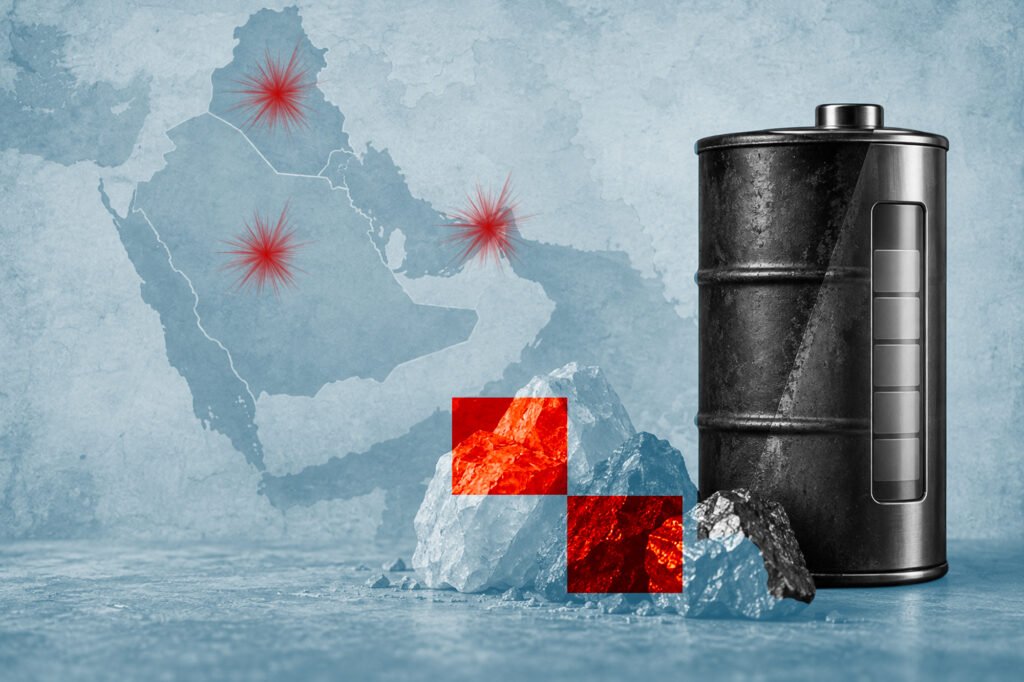
As international competition intensifies over energy resources, opportunities, and new markets created by technology, the compass of global investment is turning toward a new map of critical supply chains. The Middle East region, specifically the countries of the Gulf Cooperation Council (GCC), stands out as a strategic pillar in the trajectory of this transformation. Known for its traditional role as a primary supplier of oil and gas, this region is transitioning today into a vital hub for minerals of the future, such as lithium, nickel, cobalt, and other rare elements that constitute the primary backbone of the battery industry, electric vehicles (EVs), supercomputing, and advanced defense industries.
Global demand for minerals is projected to grow by 200% to 400% by 2040, while their processing remains concentrated in specific markets. China controls more than 70% of global refining capacity for rare minerals and nearly 60% of lithium processing. Hence lies the significance of the Gulf system as an essential bridge between raw-material-rich mines in Africa, Central Asia, and Latin America, and end-use consumer markets in the United States, China, and Europe.
Furthermore, this shift reinforces the position of the Arab Gulf states, moving them from spheres of influence and technology consumers to genuine partners and major players in national industrial security. The economic partnerships established by these countries with multiple international parties have bolstered the region’s investment presence and transformed its economic alliances into networks of both economic and political security.
In the Kingdom of Saudi Arabia, the contribution of the mining sector alone to the Gross Domestic Product (GDP) is expected to rise to $75 billion by 2030. This means the sector will constitute a fundamental source for diversifying income streams and mitigating dependence on oil price fluctuations.
This strategy also contributes to attracting foreign capital and stimulating domestic value added through the establishment of local processing and manufacturing industries rather than merely exporting raw materials. This is manifested in tangible projects, such as establishing lithium hydroxide refining complexes in the Saudi city of Jubail, nickel and cobalt processing facilities at ports in the UAE and Oman, and linking them directly to end sectors such as electric vehicle manufacturing and battery packs.
A Regional Model for Promising Investments
Gulf Sovereign Wealth Funds manage assets exceeding $4.5 trillion, a portion of which has been deployed in high-impact global acquisitions, such as the Saudi company “Manara Minerals” investing in the base metals unit of Brazil’s Vale to secure copper and nickel, alongside investment moves by the UAE’s “Mubadala” and “IHC” in copper and cobalt mines in Africa and Latakia in Syria. This runs in parallel with untapped domestic mineral wealth estimated at over $1.3 trillion in Saudi Arabia alone. Added to this are massive investments exceeding $100 billion in solar energy and green hydrogen, providing cheap, low-emission power for mineral processing at some of the world’s lowest operating costs and near-zero carbon footprints that satisfy stringent Environmental, Social, and Governance (ESG) standards.
This distinct dynamic in the mining sector can serve as a launchpad for a cross-border regional model. The transfer of Gulf expertise and capital, coupled with Western technology and partnerships, has created a scalable regional framework extending to other regional states that place mineral resource development at the core of their governmental and reform agendas. Iraq represents a genuine model for implementing this policy, as the country possesses promising non-oil mineral resources with an estimated potential market value exceeding $16 trillion, including the world’s second-largest phosphate reserves at over 10 billion tons, alongside massive reserves of free sulfur and ultra-pure silica sand. Therefore, any integration of these Iraqi capabilities within Gulf partnerships, investments, and American technologies will yield significant outcomes, opening the door to direct annual returns of up to $5 billion. It will also contribute to forming a unified regional mineral investment belt, raising the added value of raw materials in the Middle East and ensuring a sustainable stream of developmental revenue outside the umbrella of oil.
Obstacles, Challenges, and How to Overcome Them
These immense investment opportunities in the mineral sector face a range of challenges and obstacles that can be overcome, but require regional and international cooperation and coordination to surpass them at lower costs and risk while achieving higher margins and returns. Volatility in global mineral prices and declines in global exploration spending during certain periods deter some investors from taking on such risks. While this represents a source of concern, it can be mitigated by building strategic stockpiles and establishing long-term supply contracts with major manufacturers, reducing uncertainty and providing investors with greater confidence.
The technological factor and knowledge gap also emerge, particularly in advanced separation and refining technologies for rare elements, where China holds a dominant share of proprietary technological know-how. This issue can be addressed through joint ventures for knowledge transfer and by making technology localization a condition for sovereign capital injections into global firms. However, this is not straightforward; the United States imposes restrictions on transferring advanced technology to partners who maintain deep technological ties with China, which will inevitably affect future relations between the region and international players in this field. To mitigate political friction, regional states can establish supply chains compliant with Western standards for sensitive industries, without conflicting with open partnerships in traditional logistics sectors.
Moreover, strict environmental standards represent an influential factor in this type of investment. Mineral processing is among the most water-intensive activities, which conflicts with the arid desert environment of the region. The agricultural sector’s struggle with drought and elevated temperatures further compounds the risks associated with such projects. Overcoming this environmental challenge is feasible but costly; it can be achieved by linking refining complexes to water desalination plants powered by solar energy and green technologies, necessitating substantial investments in related infrastructure.
It appears that the Arab Gulf states, having overcome numerous challenges, have chosen to pursue this path and leverage their resources and minerals in a manner that secures a stable and secure future. The integrated industrial and logistics clusters currently under construction, along with their direct integration into advanced value chains that manufacture batteries and precision components locally prior to re-export, provide clear evidence of tangible progress toward new value chains in the global economy.
Sources
- International Energy Agency (IEA): https://www.iea.org/reports/the-role-of-critical-minerals-in-clean-energy-transitions
- United States Geological Survey (USGS): https://www.usgs.gov/centers/national-minerals-information-center/mineral-commodity-summaries
- Saudi Ministry of Industry and Mineral Resources: https://www.mim.gov.sa
- Sovereign Wealth Fund Institute (SWFI): https://www.swfinstitute.org
- Center for Strategic and International Studies (CSIS): https://www.csis.org/analysis/geopolitics-critical-minerals
- Atlantic Council: https://www.atlanticcouncil.org/programs/geoeconomics-center