Among the documents preserved in the Vatican Apostolic Archive is a letter that illustrates a largely forgotten history of relations between Europe and the Middle East. Written on a roll of Persian silk paper, it is dated 1599. Its author was Shah Abbas I, ruler of the Safavid dynasty. Its recipient was Pope Clement VIII (1592-1605).
“May the doors of truth, friendship and benevolence, and the rules of concord […] be opened between us, through the movement of the chain of secrets between us on both sides… so that concord may become firmer day by day…” (ASV, Fondo Confalonieri, 22, ff. 309r-310v).
The document bears a seal invoking, in its upper part, “God, Muhammad and Ali,” and, in its centre, the shah’s signature: “Abbas, servant of Ali.” More than a simple diplomatic correspondence, this letter – and the hundreds that followed it – reveal the existence of a political and religious dialogue between Rome and Persia at a time when relations between Christian and Muslim worlds are generally described through the prism of confrontation.
The history of relations between the Holy See and the Shiite world did not begin with the Islamic Republic of Iran. Its roots lie in the Safavid period, when Persia made Twelver Shiism the religion of the state and sought to establish alliances capable of counterbalancing the power of the Ottoman Empire. From the end of the sixteenth century onward, regular exchanges were established between the popes and the Persian sovereigns. Correspondence, embassies, religious missions and mercantile networks helped to build a relationship that would survive dynastic changes, revolutions and the geopolitical recompositions of the Middle East.
This long history sheds light on an often overlooked singularity: whereas relations between Iran and many Western states have undergone profound ruptures since 1979, the dialogue between Tehran and the Vatican has never ceased. The forms of this relationship have changed, but a diplomatic channel has remained open. To understand this continuity, one must return to its origins.
An alliance against Ottoman power
In the sixteenth century, Safavid Persia and Catholic Europe shared a common adversary: the Turk, that is, the Ottoman Empire. For the Safavid sovereigns, the adoption of Shiism as the religion of the state was both a strong marker of identity and an instrument of political centralization against their Sunni rivals. For the European powers, Persia appeared as a potential partner capable of exerting military pressure on the eastern flank of the Ottoman Empire.
It was in this context that the first diplomatic exchanges between Rome and Isfahan emerged. A few weeks after the Battle of Lepanto (7 October 1571), on 16 November 1571, Pope Pius V addressed a letter to Shah Tahmasp I encouraging him to continue the struggle against the Ottomans. This convergence of interests did not lead to a formal military alliance, but it opened an unprecedented space of dialogue between two powers that each understood itself as bearing a universal mission.
Under the reign of Shah Abbas I, this policy took on a new scale. The Safavid ruler sought to modernize his army, develop international trade and strengthen his position vis-a-vis Istanbul. Relations with Rome formed part of this broader strategy of diplomatic opening toward Europe.
The letters exchanged with the Holy See show that the issues went beyond military considerations alone. The two parties gradually developed a common diplomatic language that made it possible to overcome confessional differences. The Safavid sovereigns recognized the pope’s authority over Christian princes, while Rome presented the Persian sovereigns as legitimate interlocutors despite doctrinal divergences. This mutual recognition constituted one of the foundations of the lasting relationship that was established between the two states.
“I desire that Christians should go and come through my kingdom, for Your Holiness is, among Christian princes, the Vicar of Christ, to whom they render true obedience. In everything that Your Holiness shall command, I shall always be ready to obey. I pray God to maintain this friendship between us” (BAV, Vat. Pers. 165).
The intermediaries of empire: missionaries and Armenian merchants
The relationship between Rome and Persia did not rest solely on exchanges between sovereigns. It relied on a whole range of actors who ensured the circulation of people, information and texts between the two worlds. Among them were Catholic missionaries, but also Armenian merchants settled in Iran.
From the end of the sixteenth century, the Discalced Carmelites, Augustinians and Capuchins obtained authorization to establish themselves in several Persian cities. Their presence served religious purposes, but it also had a diplomatic dimension. Religious men acted as interpreters, advisers and sometimes even liaison agents between the Safavid court and the Holy See. Their reports fed the knowledge that Rome gradually acquired of Persian society and the Shiite clergy.
Theological debates occupied an important place in these exchanges. Missionaries and Shiite scholars discussed the nature of Christ, religious authority and the role of saints in the economy of salvation. These controversies produced few significant conversions, but they helped to establish forms of mutual respect between two strongly structured religious traditions. The missionaries discovered a clergy endowed with solid institutions and a developed learned culture; the Shiite authorities, for their part, encountered interlocutors capable of reasoning from religious categories comparable to their own.
The Armenians played an equally decisive role. At the beginning of the seventeenth century, Shah Abbas I displaced tens of thousands of Armenians to his new capital, Isfahan. In the suburb of New Julfa, these communities quickly became essential actors in the international silk trade. Through networks extending from India to the Mediterranean, they also ensured the circulation of letters, diplomatic information and official envoys.
Many of these merchants mastered several languages and frequented both European courts and Persian administrations. They constituted an indispensable intermediary between two spaces separated by the Ottoman Empire. Without them, a large part of the correspondence between Rome and Isfahan would probably never have reached its destination.
This mediating function gradually gave Armenians a particular place in relations between the Vatican and Persia. In Rome, they appeared as representatives of ancient Christian communities of the East. In Persia, they were perceived as loyal subjects whose commercial activities contributed to the prosperity of the kingdom. This double belonging enabled them to occupy a unique space of negotiation between the two powers.
A relationship that survived empires
The disappearance of the Safavid dynasty in the eighteenth century did not put an end to dialogue with Rome. Despite dynastic changes, wars and internal crises, diplomatic contacts continued. In the nineteenth century, under the Qajars (1789-1925), these exchanges nevertheless took on a new form.
Europe was no longer merely a potential military partner; it had become a dominant economic and political power. Persia now sought to preserve its autonomy in the face of Russian and British ambitions. In this context, the Vatican had a particular advantage: unlike the major European powers, it had no territorial ambitions in the Middle East.
The letters exchanged between Qajar sovereigns and the popes testify to this evolution. When Naser al-Din Shah sent his congratulations to Leo XIII in 1887, the tone differed markedly from that of the Safavid correspondence. There was no longer any question of a military alliance against the Ottomans. The vocabulary placed greater emphasis on peace, friendship among peoples and the maintenance of durable relations.
The Holy See then appeared as an institution capable of offering a form of international recognition without directly participating in the imperial rivalries that traversed the region. For chiite sovereigns, this relationship provided a way to widen their diplomatic margins in a context marked by the progressive weakening of their power.
This continuity eventually led to the establishment of official diplomatic relations between Iran and the Holy See in the mid-twentieth century. When Mohammad Reza Pahlavi came to power, exchanges between Rome and Tehran already rested on several centuries of uninterrupted contacts.
1979: why the Vatican did not break with Iran
The Islamic Revolution of 1979 was a moment of rupture in relations between Iran and Western powers. The fall of the Pahlavi monarchy (1925-1979) and the establishment of the Islamic Republic led many governments to reconsider their relations with Tehran. Iran gradually became one of the principal sources of tension in international politics.
In this context, the attitude of the Holy See appears singular. Whereas most Western chancelleries approached the new regime through the prism of ideological or security confrontation, the Vatican chose to keep its channels of communication open. Diplomatic relations were not interrupted; the consulate remained open. Pontifical representatives stayed in place, and exchanges continued despite successive crises.
This continuity can be explained first by an ancient institutional memory. For Vatican diplomacy, the Islamic Republic did not emerge in a historical void. It belonged to a long tradition of government in which religious authority occupied a central place in the organization of political power. Since the Safavid period, Rome had learned to speak with interlocutors whose legitimacy rested largely on their religious status.
Unlike many Western observers who interpreted the Iranian Revolution as a political anomaly, the Holy See also saw in it the expression of a religious and institutional culture with which it had several centuries of experience. This did not mean adherence to the orientations of the Islamic Republic, but the recognition of an interlocutor whose internal logics were considered intelligible.
This difference of perception became particularly visible during the American hostage crisis between 1979 and 1981. In this climate of extreme tension, an exchange of prophetic frankness took place, illustrating the mutual recognition of two moral authorities. In December 1979, Ayatollah Khomeini addressed a striking message to Pope John Paul II and to Christians throughout the world, affirming that “if Jesus Christ were present today, he would reprimand President Carter” for his conduct toward the Iranian people. By directly addressing the Supreme Pontiff, the Imam was not speaking to a foreign head of state, but to the representative of a prophet whose legacy of justice he also claimed, calling on the Vatican to side with the “oppressed” (mostazafin) against the arrogance of the powerful.
The interventions of Pope John Paul II then combined moral condemnation of the hostage-taking with the maintenance of direct dialogue with the Iranian authorities. This double posture became one of the characteristics of pontifical diplomacy in the Middle East: never to renounce criticism, but to avoid rupture as far as possible. The same logic can be found in the following decades. Despite controversies linked to Iran’s nuclear programme, regional conflicts and human rights issues, the Holy See continued to consider dialogue a priority diplomatic instrument. This position rests on an old conviction: the most durable crises cannot be resolved solely through isolation or sanctions.
A dialogue founded on the recognition of religious authorities
If relations between Rome and Tehran survived such profound political changes, it is also because they rest on a particular form of mutual understanding between religious institutions.
Roman Catholicism and Twelver Shiism are strongly hierarchical traditions. Both accord an important place to clerical authority, to the learned transmission of religious knowledge and to institutional continuity. The doctrinal differences remain considerable, but they do not prevent the existence of a shared language concerning the role of religion in public life.
This structural proximity appears regularly in encounters between Catholic leaders and Shiite authorities. Since the 1990s, academic and theological exchanges between Rome, Qom and other centres of study have multiplied. The aim is not to reduce doctrinal divergences, but to create spaces where they can be discussed without calling the legitimacy of the other into question.
Beyond official diplomacy, a major intellectual project has also shaken the foundations of Shiite thought in Iran. For several decades, a generation of “new theologians” (no-andishan) has engaged in a radical critique of its heritage in order to found a “new theology” (Kalam-e Jadid). In both law and fundamental theology, the question of freedom has become the central pivot of their projects. In some respects, this internal transformation resembles a genuine Shiite “theology of liberation.”
On several occasions, the Vatican and Iran have also found themselves holding similar positions in international debates concerning the family, bioethics or the place of religion in contemporary societies. These punctual convergences should not be interpreted as a political alliance. Rather, they testify to shared concerns about the effects of certain global cultural transformations.
Vatican diplomacy has thus gradually developed a particular approach to Iran. Where other actors see primarily a geopolitical adversary, it also perceives a religious partner with whom dialogue remains possible despite disagreements.
Najaf, 2021: the Iraqi depth of the Shiite world
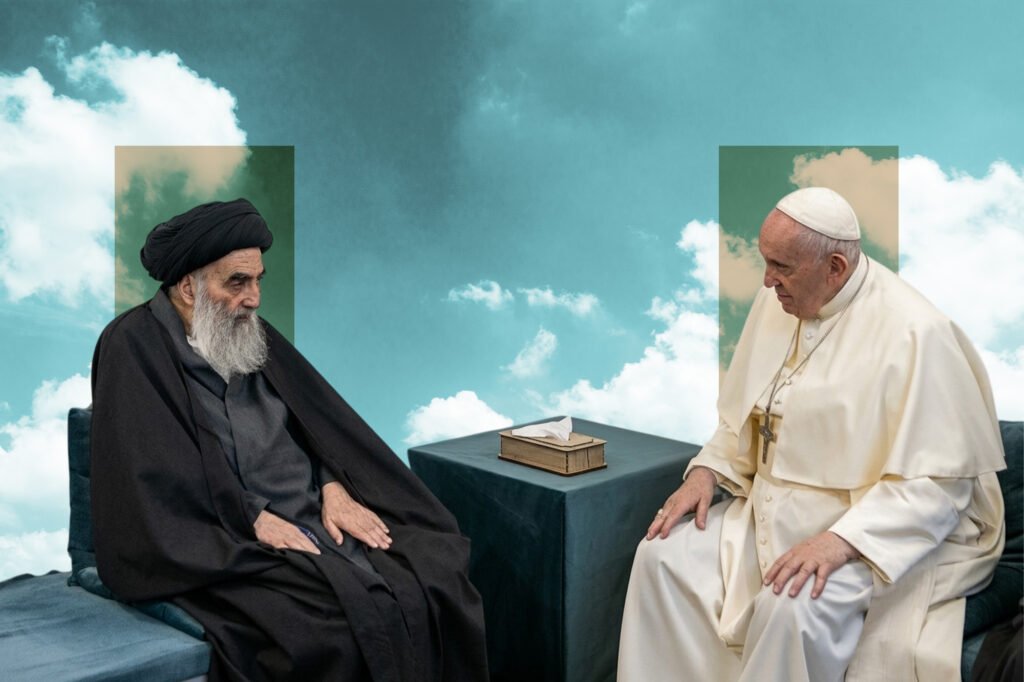
On 6 March 2021, Pope Francis met in Najaf with Grand Ayatollah Ali al-Sistani, one of the highest religious authorities of contemporary Shiism. The image quickly travelled around the world: in a modest house in the old city of Najaf, two of the most influential religious figures of their time met far from diplomatic summits and protocol staging.
The place of the meeting is crucial. Francis did not go to Tehran, the political capital of the Islamic Republic of Iran, but to Najaf, in Shiite Iraq. This choice does not diminish the historical importance of Iran in the formation of modern Shiism; rather, it recalls that the Shiite world cannot be reduced to the Iranian state or to the political configuration established after 1979. Iraq is one of the historical cradles of Shiite religious memory, scholarship and authority. Kufa, Najaf, Karbala, Kadhimayn and Samarra form a sacred and learned geography linked to the imams, to martyrdom, to pilgrimage, to jurisprudence and to the transmission of religious knowledge. Najaf in particular is not merely a holy city. It is the seat of a scholarly tradition whose authority extends across Iraq, Iran, Lebanon, the Gulf, South Asia and the wider Shiite world.
The meeting must certainly be situated in the particular context of post-ISIS Iraq, marked by sectarian violence, the displacement of populations and the vulnerability of Christian communities. But it goes well beyond the Iraqi framework alone. It represents one of the most significant moments in the dialogue pursued for centuries between the Holy See and the different authorities of the Shiite world. At the same time, it introduces a decisive shift: the interlocutor is not a sovereign, a government or a state institution, but a religious authority rooted in the Iraqi hawza and recognized far beyond national borders.
Ali al-Sistani occupies a singular place in this religious landscape. Heir to the learned tradition of Najaf, he defends a conception of religious authority that privileges moral influence over the direct exercise of political power. His prestige extends well beyond Iraq and reaches the whole Shiite world. This distinction is essential for understanding the gesture of Pope Francis. By going to Najaf, he recognized not only a representative of Iraqi Shiism, but a form of religious authority whose legitimacy does not depend primarily on state power.
The language used during this exchange is revealing. Sistani does not speak of religious “minorities,” but of the “components” (mukawwinat) of Iraqi society, refusing the condescension of tolerance and preferring to it the equality of constitutional rights. By listening to al-Sistani affirm that Christians must live in peace and security like all Iraqis, Francis recognized an Iraqi Shiite voice capable of speaking not only for one community, but for the shared dignity of the whole society.
In choosing to travel to Najaf, Francis therefore acknowledged an authority and affirmed that religious institutions remain essential actors in contemporary international relations. The gesture was also significant for Shiite authorities, who could see in this visit a recognition of their role in the stabilization of the region and in the protection of Christian communities. But the gesture has a further meaning: it shows that dialogue with the Shiite world does not pass only through Tehran. It also passes through Iraq, through its holy cities, through its scholarly institutions and through a religious memory older than the modern states of the region.
The statement issued after the meeting insisted on the need to guarantee Eastern Christians the right to live in security and to participate fully in the life of their societies. This concern is not new. It runs through the history of relations between Rome and the Shiite world from the first Safavid correspondence of the seventeenth century, when Persian sovereigns already promised protection to Christian communities established in their kingdom.
More than a diplomatic event, the meeting in Najaf revealed the permanence of a particular mode of dialogue. Whereas contemporary international relations are often analysed through military or economic power relations, it reminds us of the existence of other forms of legitimacy founded on religious authority, historical memory and the ability to speak in the name of transnational communities. Najaf is therefore not the simple culmination of five centuries of relations between Rome and Persia. It is rather the contemporary reactivation, in Iraqi Shiism, of a diplomatic repertoire of recognition, presence and maintained contact that the Vatican archives allow us to follow across time.
Conclusion
The history of relations between Rome and Persia, and then between the Holy See and contemporary Iran, invites us to move beyond simplified representations that mechanically oppose the Christian West to the Muslim world. Since the beginning of the seventeenth century, the archives reveal, on the contrary, a succession of exchanges, negotiations, disagreements and rapprochements that made it possible to maintain an almost uninterrupted dialogue.
The forms of this relationship changed profoundly over time. Projects of military alliance against the Ottoman Empire were followed by religious missions, Armenian mercantile networks, intellectual exchanges and, later, contemporary diplomatic relations. Yet the same question runs through these five centuries of history: how can durable relations be established between powers whose legitimacy rests on different religious traditions, each universal in its claims?
The letter sent by Shah Abbas I to Clement VIII in 1599 appears today as one of the first traces of this question. Behind diplomatic formulas and strategic calculations, one can already discern the desire to invent a common language between two worlds often presented as irreducibly opposed.
More than four centuries later, as regional crises continue to redraw the Middle East, this long history helps us understand why dialogue between Rome and the Shiite world has survived wars, revolutions and regime changes. It also shows that diplomatic archives preserve not only the memory of states: they keep the trace of continuously renewed efforts to hold open the possibility of dialogue between different religious and political universes.
The views and opinions expressed in this paper are solely those of the author and do not necessarily reflect the official policy or position of the Institute.