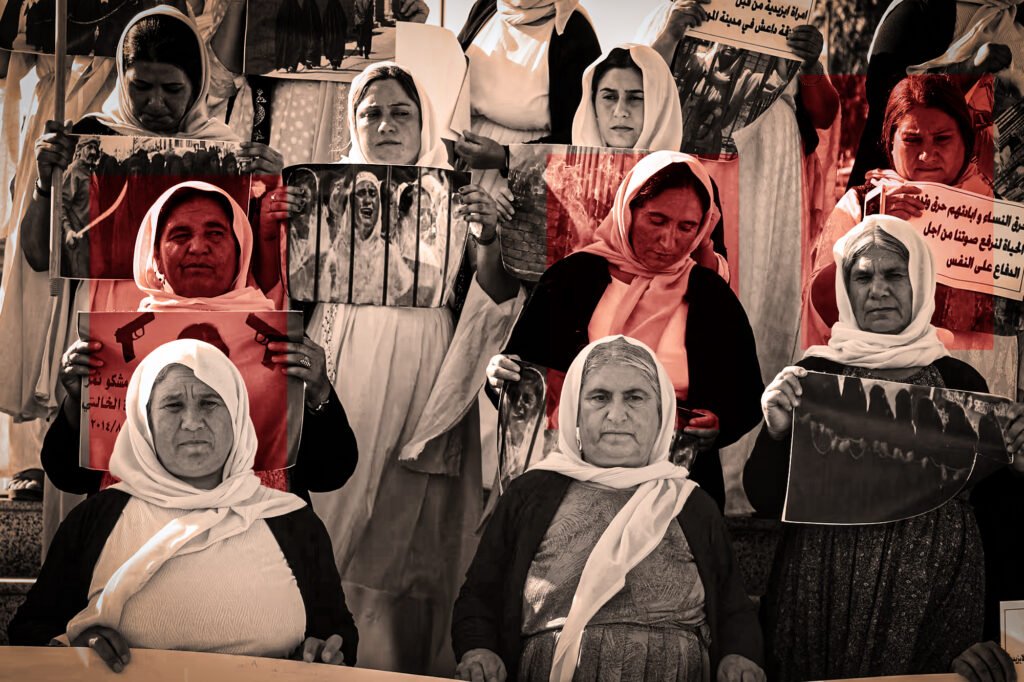
Sinjar, or Shingal, as its people call it, is not merely a district or a city; it is a deep Iraqi wound left untreated for far too long, and a global human tragedy whose story has reached the ends of the earth. Through the suffering of its people, the tragedy of the Iraqi nation and its various components reached the world stage, showcased both in its resilience against terrorism and its confrontation with international crimes, chief among them genocide.
Driven by the advocacy of Yazidis and Iraqi victims, the United Nations established the UNITAD team, which legally recognized that ISIS committed genocide against the Yazidis, thereby documenting not only the tragedy of the Yazidis but the tragedy of Iraq as a whole. As a result of this collective advocacy, Iraq received its first Nobel Peace Prize, an accolade that served as an acknowledgment of the suffering and endurance of an entire people, rather than just an individual.
The Yazidis in Iraq are far from being a marginal component, despite the severe population decline caused by mass migration, especially after 2014, which forced over 150,000 to flee their homes. Nevertheless, more than 600,000 Yazidis still live in Iraq, concentrated in highly critical and strategic geographic areas such as Sinjar, the Nineveh Plains, and Duhok, making up approximately 2% of Iraq’s population. Their importance is not limited to numbers or strategic location; it extends to their rich cultural contributions, unique identity, and a history spanning thousands of years.
The Yazidis entered global consciousness through the suffering they endured, and numerous nations recognized the genocide against them, including major powers like the United States, the United Kingdom, Germany, the Netherlands, Australia, Canada, and others. Domestically, the government of Mustafa Al-Kadhimi introduced the first draft legislation criminalizing the genocide perpetrated against the Yazidis and the Shia Turkmen of Tal Afar. This statute remains a landmark legal instrument, arguably the only one of its kind in Iraq and the Middle East to explicitly codify and condemn acts of genocide.
As a result of these campaigns launched primarily by the Yazidi elite and the diaspora, and with growing global awareness of their cause after being a relatively insular community, they have gained many friends and supporters worldwide. Today, their cause enjoys great attention in international circles. Alongside a large diaspora estimated at about half a million people, the Yazidis now serve as a real bridge connecting Iraq to the world. They can strengthen Iraq’s engagement with the international community while contributing to the reconstruction of both Iraq and the devastated Yazidi homeland.
The Current State of Recovery: A Mixed Record
The path toward post-genocide recovery yields mixed indicators, balancing the positive and the negative. Twelve years after the ISIS campaign of systematic abductions and enslavement, the fates of more than 2,600 missing Yazidi men and women remain entirely unknown. Furthermore, over half of the Yazidi population remains displaced, languishing across 15 internal refugee camps within the Kurdistan Region.
Administratively, Sinjar and its northern sub-district of Al-Shamal remain without a stable local government. The primary challenge remains the security situation, as Sinjar is trapped within a complex web of overlapping regional, international, and domestic conflicts. Compounding this gridlock, only 5% to 10% of financial compensation has been disbursed to residents and displaced persons. Crucially, the exhumed remains of genocide victims have yet to be returned to their families for dignified burials. Instead, they remain stored alongside thousands of unidentified Iraqi bodies at the Medico-Legal Directorate in Baghdad, due to a lack of sufficient funding and the administrative support required to expedite DNA identification.
The Sinjar Agreement: Flawed Assumptions
The Sinjar Agreement has consistently failed to garner acceptance from the majority of the Yazidi public. Many Yazidis link its implementation to a retroactive return of conditions to the pre-2003 status quo. However, this reading is inaccurate if we examine the text of the agreement. The accord does not mandate the return of pre-2014 armed factions, regardless of their source; rather, it stipulates the expulsion of Kurdistan Workers’ Party (PKK) forces and affiliated militias, alongside a joint administration coordinated with the Kurdistan Regional Government (KRG). In reality, these measures lacked political and security pragmatism on the ground, and suffered from a severe deficit of broad grassroots legitimacy and political pressure necessary for their success.
Today, Sinjar has lost its former status as a primary political or strategic lever for Kurdish political parties, devolving instead into a secondary negotiating chip. Conversely, the Yazidis remain an important electoral constituency, though their relative leverage has noticeably waned, particularly after the Yazidi Cause Alliance secured more than half of the community’s votes, drawing thousands of ballots from the displacement camps.
Geopolitical Rivalries and the Security Impasse
From a security standpoint, Sinjar sits at the heart of the volatile trilateral dynamics connecting Ankara, Baghdad, and Washington. The Turkish state demands a Sinjar completely cleared of the PKK. Meanwhile, the United States prioritizes the removal of the Popular Mobilization Forces (PMF) alongside a significant reduction of the PKK presence, a stance designed to appease Turkey and align with regional policies influenced by figures such as Tom Barrack.
Geopolitical friction between Iran and the United States effectively averted a near-certain military conflict in Sinjar last March. At that time, the Iraqi state issued an ultimatum to the Sinjar Resistance Units (YBŞ), a localized Yazidi faction accused by its detractors of ideological and organizational alignment with the PKK, and to the PKK itself. They were ordered to disarm and evacuate the district or face a military operation by Iraqi federal forces deployed to enforce control.
Although broader regional conflicts and negotiations ultimately prevented open warfare, integration into the state apparatus remains profoundly incomplete. The Yazidi public overwhelmingly favors the structural integration of localized forces into official federal security institutions, coupled with a negotiated, non-violent exit of the PKK. The alternative, a military campaign, risks triggering a catastrophic humanitarian crisis and a fresh wave of mass displacement that could permanently depopulate Sinjar. Indications suggest that the Iraqi leadership is similarly banking on a negotiated settlement to prevent the shedding of Iraqi blood and avoid expending vast state resources on an internal war.
Furthermore, recent structural shifts within Syria, which effectively severed the logistical and operational supply lines between Mount Sinjar and northeastern Syria (controlled by the Syrian Democratic Forces), have introduced a new strategic dynamic. This isolation provides the Iraqi government with an opportunity to apply calibrated pressure. Capitalizing on this opportunity, however, requires explicit political resolve and dedicated financial appropriations to provide disarmament, demobilization, and reintegration (DDR) options for local fighters, alongside serious diplomatic engagement to permanently resolve the PKK presence.
A Roadmap for Stabilization and Development
Our vision, which reflects the consensus of the vast majority of Yazidis and the broader citizenry of Sinjar, rests upon a clear paradigm: the security architecture of the district must be completely insulated from domestic political interference and external geopolitical rivalries. Security must be localized and placed in the hands of local forces to restore institutional trust. This is an absolute psychological necessity; the collective memory of Sinjar’s population remains deeply scarred by the cataclysmic security collapse and sudden withdrawal of forces in 2014, which directly paved the way for the genocide.
Administratively, the new Prime Minister has an optimal window of opportunity to resolve this issue through a comprehensive settlement, providing the groundwork for a political understanding within the Nineveh Provincial Council. This requires formally appointing a permanent District Governor (Qa’immaqam) and a director for the Al-Shamal sub-district, and returning civil institutions to their normal work, especially since nearly half of these municipal bodies continue to operate out of provisional locations outside the district.
The comprehensive reconstruction of Sinjar district and turning it into a model to be emulated can send a strong message to the whole world that Iraq is an inclusive state for all its citizens, and that its minorities are not peripheral elements but rather essential, strategic pillars in state-building and the nation’s future. Turning Sinjar into a secure and prosperous region manifests Iraq’s capacity to transcend its deepest historical wounds and reconstruct its national unity on the foundational pillars of justice, equality, and the recognition of diversity as a core strength rather than a point of vulnerability.
Like many other regions of Iraq, there is an urgent need to generate sustainable employment opportunities for thousands of residents, revitalize the economic fabric of the district, and convert existing challenges into real development opportunities that ensure communal stability and reduce the motives for future migration or displacement. The return of displaced persons to their homes and the prompt payment of compensations due to them is a humanitarian and national priority that cannot tolerate delay. The continued suffering of more than half of the Yazidi population in the displacement camps hinders any serious effort for recovery and delays building trust between the citizen and the state.
A specialized national security taskforce must be formed in cooperation with the relevant international entities for a serious and continuous search for the abducted men and women whose fate remains unknown after more than twelve years. This humanitarian file remains an open wound that demands strong political will and concentrated intelligence resources to close it and return hope to the waiting families. Also, it is necessary to remove what remains of the mass graves and return the remains of the victims to their relatives with the utmost respect and dignity as a basic symbolic and humanitarian step toward collective healing and restoring dignity to the victims and their families who have waited for this moment for long years.
Accelerating the construction of the approved University of Sinjar represents a vital, long-term educational and economic investment in the future of the district and its people. This institution will open wide horizons for the Yazidi and Iraqi youth in the region, provide locally accessible higher education to mitigate the pressures of forced migration, and contribute to preparing qualified national cadres capable of leading reconstruction and sustainable development operations, turning Sinjar into an educational and cultural center serving western Nineveh and Iraq as a whole.
Confronting desertification and water scarcity in western Nineveh constitutes an urgent environmental challenge that can be faced through building small and medium dams to harvest rainwater, and restarting and expanding the Al-Jazeera Irrigation Project. These sustainable measures will secure the water supply necessary for agriculture and the daily uses of the population, fight desertification that threatens fertile lands, and support the agricultural sector as a basic source of livelihood and economic stability—which encourages the return of displaced persons and builds a solid foundation for a dignified life and agricultural development in the region.
Conclusion
In conclusion, ensuring meaningful Yazidi participation in political and administrative decision-making at both local and national levels, and fully benefiting from the capabilities and expertise of the community members at home and in the diaspora, is the surest guarantee for the success of any settlement or reconstruction project. The Yazidis, who proved their resilience and loyalty to Iraq in the darkest circumstances, possess exceptional expertise and professional capacity that can be employed effectively in the service of the nation, whether through local political and administrative cadres or through the diaspora abroad, which represents a vital bridge with the world that Iraq can employ for the supreme national interest of Iraq.
The views and opinions expressed in this paper are solely those of the author and do not necessarily reflect the official policy or position of the Institute.